
Part 1: Ad Monetization Stack Optimizations
Updated: Jun 5
With whatever current ad monetization you are running, there is always the challenge of how you can optimize and squeeze more out of what you’ve built. There are lots of directions you can go in, but these decisions are hard, requiring lots of A/B testing, established telemetry, analysis and tough decisions. With MDN11 we can make those decisions easier, take into account any setup that you have and optimize it to be the best it can be. Let’s take a look at some classic modes of operation for ad platforms and their more advanced utilizations.
Waterfall mediation
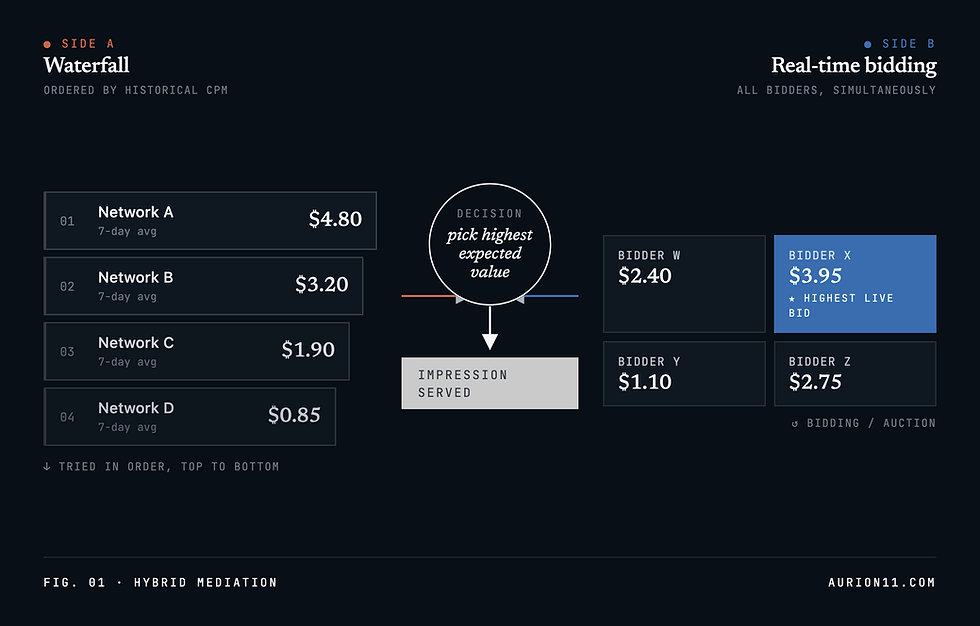
This is increasingly a legacy concept now that bidding has taken over on mobile, but it’s still relevant in hybrid setups. It uses multiple calls to the same network at various set CPMs, ordered by historical performance data to maximize revenue from each opportunity. On its own, it's a blunt instrument, but combined with real-time bidding, it becomes more interesting - that’s what we call a Hybrid mediation.
Hybrid mediation
This is the current default for most mediation platforms, combining real-time bidding with historical performance-based waterfalls. The tricky part is deciding what to prioritize when you're comparing a live bid price against a historical CPM. They're not directly comparable, but there are effective ways to handle this. If you're building your own mediation stack rather than using an off-the-shelf platform, this is something you'll need to think through carefully.
Bid floor price optimization
When using the bidding part of the mediation platform, your floor price dictates the minimum you're willing to accept for an impression. Most mediation platforms let you set this, and many publishers use it as a simple blanket setting i.e.something like $0.20 on banners just to avoid a fire sale of impressions at $0.01. The relationship between floor price, CPM, and impression volume is important. Setting floors thoughtfully can cut off lower-quality demand, reduce impression count, and still land you at the same or better revenue with improved ad quality metrics.
Dynamic bid floor prices
If a static floor price is useful, a dynamic one can be more powerful. The idea is an algorithm that calculates optimal floor prices in real time based on historical data, current user data, app events, and whatever else is relevant to your setup. Getting this right requires either a proper data science team or a platform that already has this capability built in. MDN11 does exactly this through the use of proprietary algorithms and with minimal integration effort. You can still use your existing mediation platform and configuration, with the added benefit of optimizing it through our SDK.

Multiple mediation platform utilization
This technique lets you play to the strengths of several mediation platforms at once. Running different platforms across different user segments allows you to extract more from each. It’s an advanced approach that requires significant implementation work or a third-party SDK that already supports it. Not for everyone, but worth knowing it exists.
All of the above can be mixed, matched, and built upon. The options can get overwhelming quickly, so the practical advice is to iterate and not try to implement everything at once. Even if you know there's money being left on the table, taking on too many changes simultaneously means that when something goes wrong (and something always will!), you won't know what caused it. At Aurion11 we can help you solve the question of what methods and techniques should be used to optimize your ad stack - either through using our MDN11 SDK or you can consult us on your current stack and the challenges you are facing.
Either way, feel free to contact us and we’ll get the conversation started.

